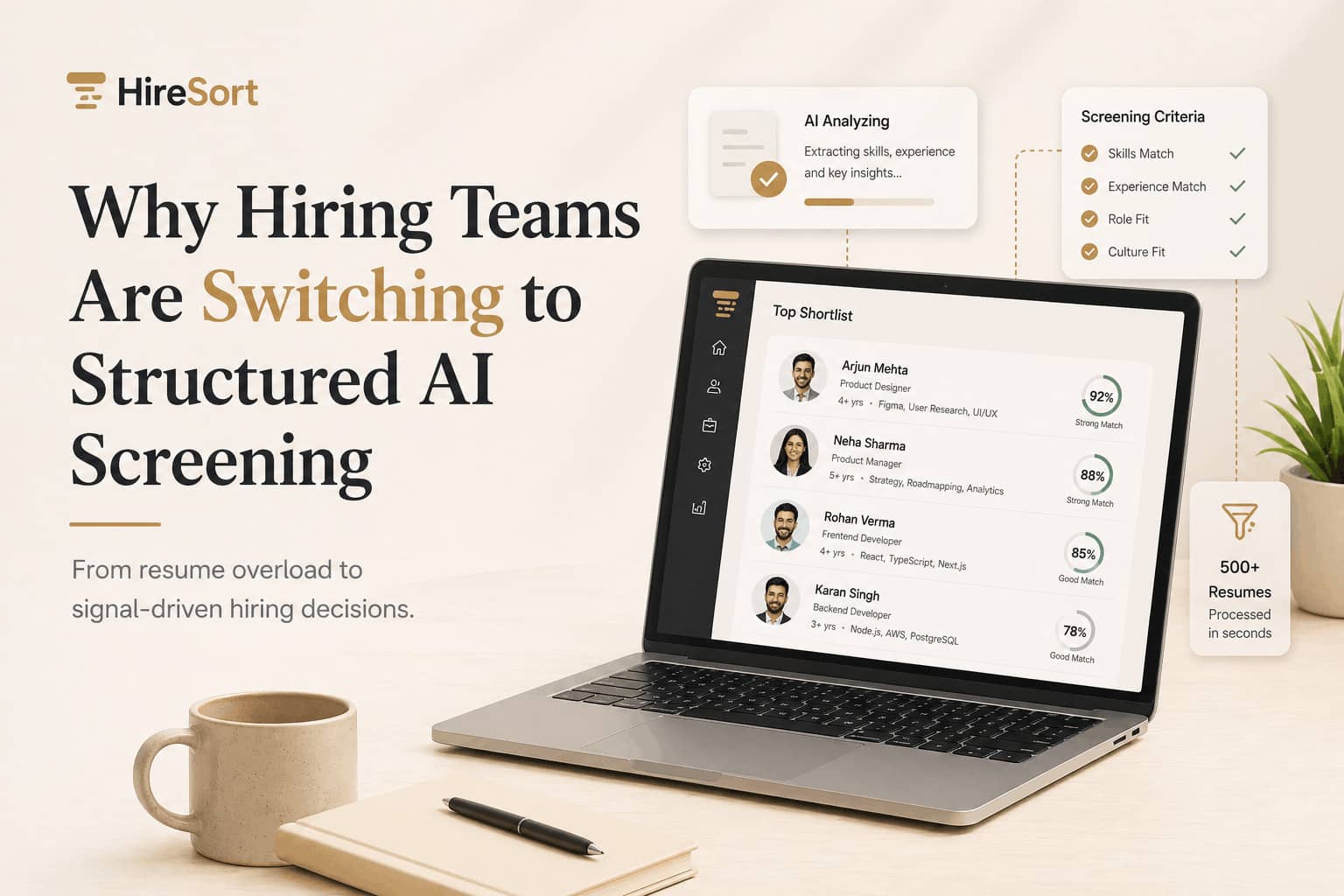
Why Hiring Teams Are Switching to Structured AI Screening
From resume overload to signal-driven hiring decisions.
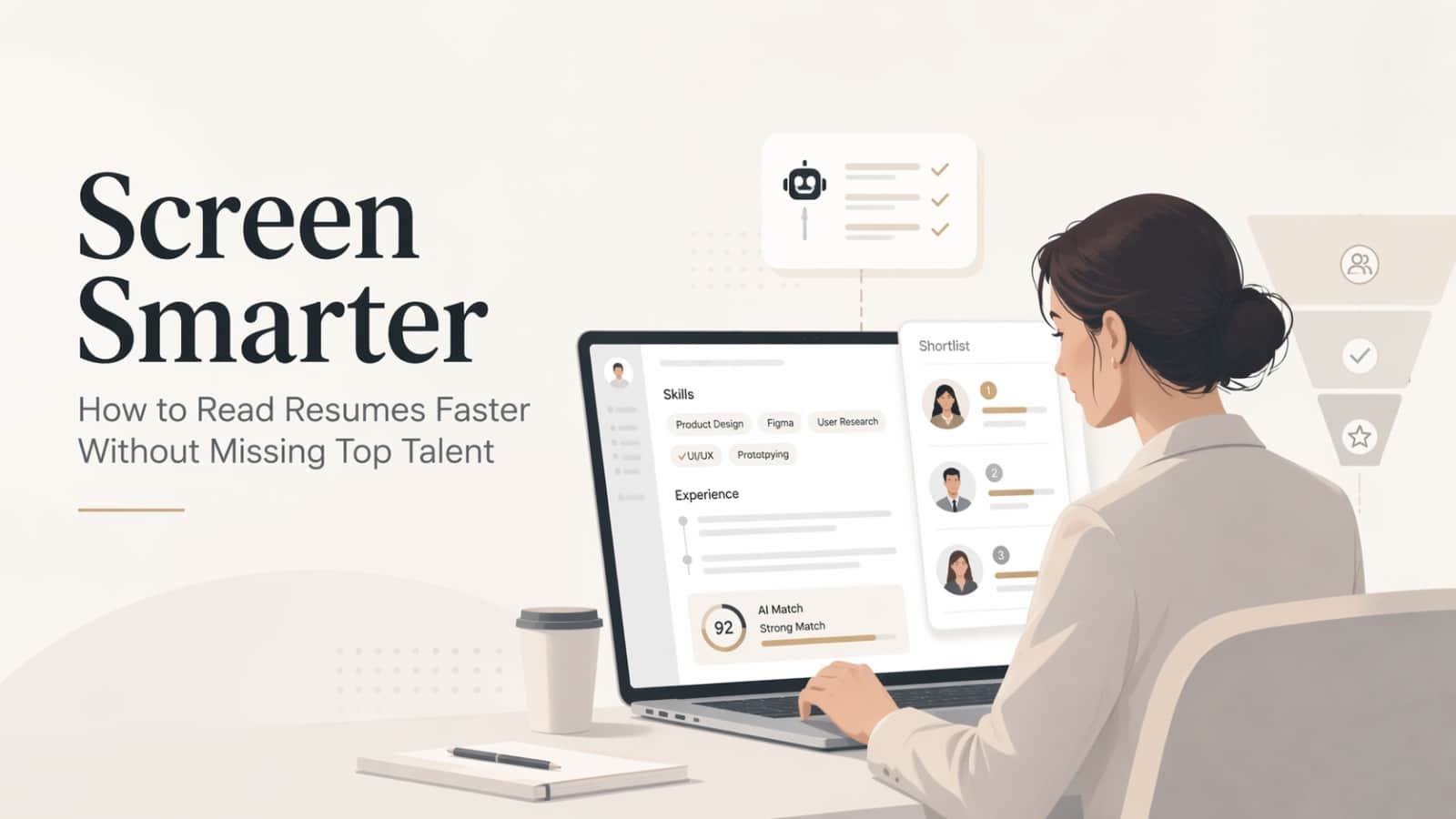
The problem: too many resumes, too little signal
Hiring today is not limited by candidate supply. It is limited by attention. Recruiters often deal with hundreds or thousands of applications per role, but only a small percentage are truly relevant. The challenge is not finding candidates—it is identifying the right ones quickly.
Traditional resume screening does not scale well. It is manual, inconsistent, and heavily dependent on individual judgment. As a result, strong candidates can be missed while time is spent reviewing low-fit profiles.
Why unstructured screening breaks at scale
Most hiring workflows rely on instinct. Recruiters skim resumes, look for familiar keywords, and make quick decisions without a shared framework. While this works at low volume, it becomes inefficient and unreliable at scale.
The lack of structure creates three major issues: inconsistent shortlists, slower hiring cycles, and difficulty comparing candidates fairly across reviewers.
What structured AI screening changes
Structured AI screening introduces a system where every candidate is evaluated against the same criteria. Instead of reading resumes line by line, hiring teams define what matters—skills, experience, impact—and let the system apply that consistently.
This is where platforms like HireSort come in. They combine structured evaluation with AI assistance to extract relevant signals, rank candidates, and reduce repetitive work.
1. Faster first-pass screening
AI can quickly process large volumes of resumes, identifying candidates who meet baseline criteria. This eliminates the need for recruiters to manually review every application in detail.
Instead of spending hours filtering, teams can focus immediately on a high-quality shortlist.
2. Consistency across reviewers
Structured scorecards ensure that every candidate is evaluated using the same framework. This reduces bias and variation between reviewers, making hiring decisions more reliable.
Consistency is what transforms hiring from a subjective process into a repeatable system.
3. Better signal detection
AI-assisted systems go beyond keyword matching. They help identify evidence of real impact—projects, outcomes, and relevant experience—rather than surface-level signals.
This allows teams to discover strong candidates who might otherwise be overlooked.
4. Reduced time-to-hire
When screening becomes faster and more structured, the entire hiring pipeline accelerates. Recruiters move quickly from application review to interviews, reducing delays and improving candidate experience.
Speed matters—top candidates do not stay available for long.
AI is not replacing recruiters—it is amplifying them
There is a common misconception that AI replaces human judgment in hiring. In reality, it removes repetitive tasks and allows recruiters to focus on higher-value decisions like candidate evaluation, interviews, and stakeholder alignment.
This hybrid approach—AI for structure, humans for judgment—is similar to how other industries are adopting AI to enhance efficiency without losing control.
What the best hiring teams are doing differently
High-performing hiring teams are not just working harder—they are working with better systems. They define clear criteria, use structured evaluation, and leverage AI to reduce manual effort.
This shift mirrors broader trends across industries where AI is used to improve personalization, efficiency, and decision-making at scale.
Closing thought
Hiring is fundamentally a decision-making problem. The faster you can identify signal, the better your outcomes. Structured AI screening is not just about speed—it is about making better decisions consistently.
That is why more teams are moving toward platforms like HireSort—to turn resume chaos into clear, ranked, and actionable insights.