Best AI Resume Screening Software for Fast-Growing Teams in 2026
What recruiters, founders, and hiring managers should look for before choosing an AI screening platform.
The best AI resume screening software is not the tool with the longest feature list. It is the tool that helps your hiring team move from applicant overload to a reliable shortlist with speed, consistency, and confidence.
For fast-growing teams, resume screening often breaks before the rest of the hiring process. A job post receives hundreds of applications, the founder or recruiter scans resumes manually, and high-potential candidates get lost because the team has no consistent scoring system. AI screening software can help, but only if it is built around the way hiring decisions are actually made.
What to look for in AI resume screening software
Before comparing tools, define the job you want the software to do. Do you only need parsing? Do you need candidate ranking? Do you need ATS workflows? Or do you need a lightweight way to create shortlists and track candidate stages? The right choice depends on your hiring volume, team size, and workflow maturity.
- Rubric-first scoring: The tool should score candidates against role-specific criteria, not only keywords.
- Explainable results: Every score should include reasoning or evidence, so recruiters can verify the output.
- Editable criteria: Hiring teams should be able to adjust weights and subcategories before screening resumes.
- Batch processing: Uploading resumes one by one defeats the purpose of automation.
- Candidate detail view: Recruiters should see the resume, score, strengths, and missing elements in one place.
- Human review controls: AI should support the recruiter, not make final decisions without oversight.
- Simple setup: Fast-growing teams need value quickly, not a long implementation cycle.
Feature checklist for 2026
In 2026, AI screening software should go beyond simple parsing. The table below shows the minimum feature set a modern hiring team should expect.
- JD-based rubric generation: Turns the job description into structured screening criteria.
- Resume parsing: Extracts text and candidate details from PDF/DOCX files.
- Weighted scoring: Allows critical skills to matter more than nice-to-have skills.
- Evidence excerpts: Shows why a score was given and reduces blind trust in AI.
- Ranked shortlist: Helps recruiters focus on top candidates first.
- Candidate repository: Makes uploaded resumes reusable for future roles.
- Stage tracking: Helps teams move candidates from new to shortlisted to interview.
Best for startups and lean teams
If your team is hiring actively but does not need a full enterprise ATS, look for a tool that solves the painful first step: screening and shortlisting. Many startups do not need complex onboarding workflows, offer management, or deep HRIS integrations on day one. They need to know which 10 candidates out of 200 deserve attention.
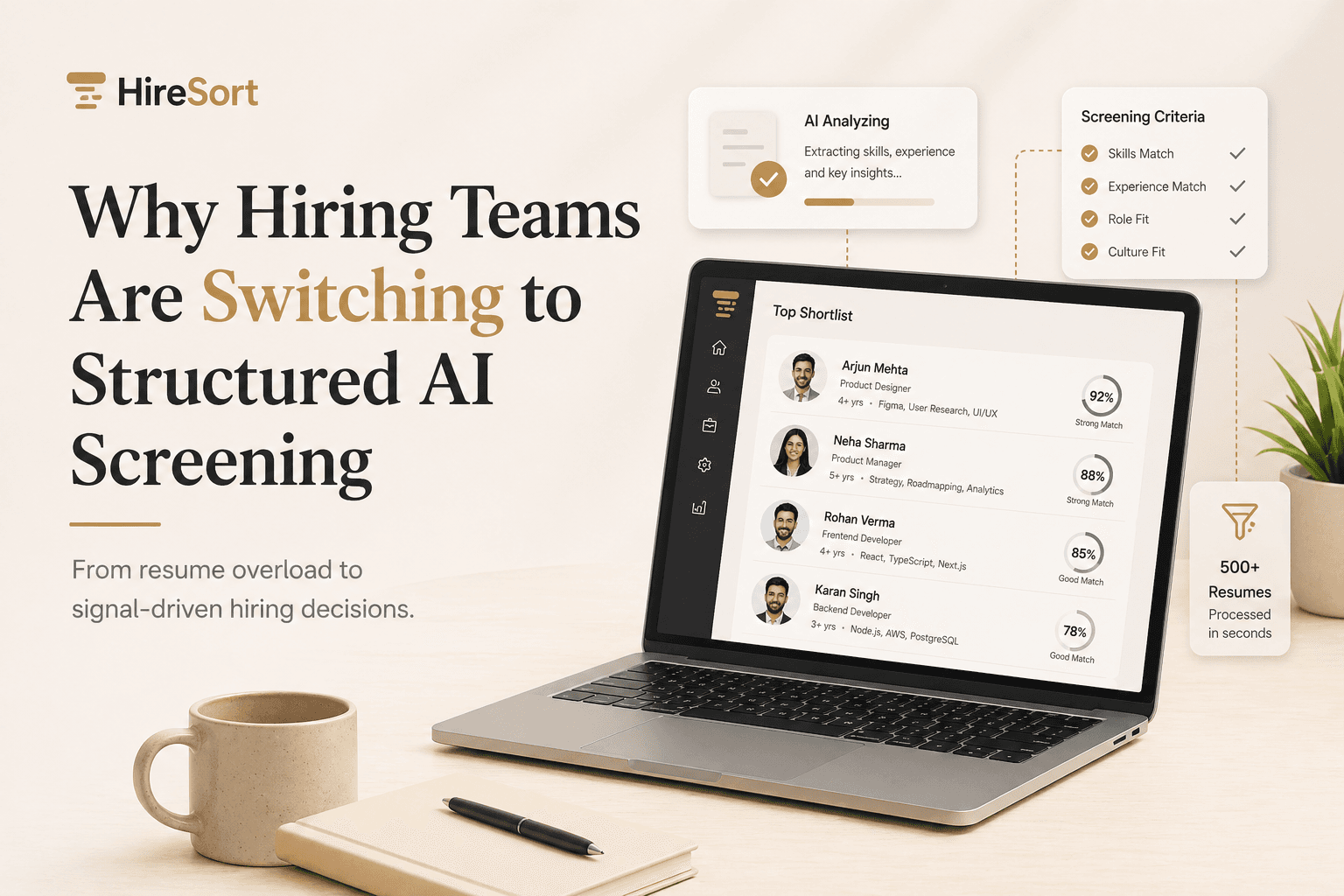
HireSort is designed for this use case. The product lets recruiters paste a job description, generate a scoring rubric, upload resumes, and receive a ranked shortlist with candidate-level explanations. This makes it useful for founders, hiring managers, startup recruiters, and recruitment agencies that need speed without giving up structure.
Best for agencies
Recruitment agencies need to process large resume volumes across many roles. For them, the best AI screening software should support batch uploads, consistent scoring, shortlist exports, and reusable candidate records. A future-ready system should also help agencies search past candidates and reuse resumes for new client roles.
Best for hiring managers
Hiring managers often complain that candidate quality is inconsistent. An AI screening tool can help them define the exact criteria that matter for a role. Instead of sending vague feedback like 'not technical enough,' the manager can review a structured breakdown across skills, experience, impact, and role fit.
Common mistakes when choosing a tool
- Choosing a parser when you actually need scoring and ranking.
- Choosing a full ATS when your main bottleneck is first-pass screening.
- Trusting black-box AI outputs without evidence or explanations.
- Using keyword filters that reward resume stuffing.
- Ignoring recruiter workflow after the shortlist is created.
Final recommendation
The best AI resume screening software for a fast-growing team should be simple, explainable, and tied directly to the job description. It should help the team move faster while keeping the recruiter in control. If your biggest bottleneck is converting a resume pile into a shortlist, HireSort is built exactly for that workflow.