Candidate Scorecard Template for Recruiters | Free Hiring Scorecard
A practical candidate scorecard template recruiters can copy to compare resumes, interviews, strengths, gaps, and next steps consistently.
Candidate Scorecard Template for Recruiters
Copy this scorecard structure before screening resumes or running interviews. It keeps every reviewer focused on the same role criteria, evidence, risks, and next step.
- Candidate and role: note the applicant name, role, source, and reviewer.
- Must-have criteria: list the skills, experience, qualifications, and constraints that are non-negotiable.
- Scoring scale: use the same 1-5 or 1-10 scale for every candidate.
- Evidence notes: capture the resume line, project, metric, or interview answer behind each score.
- Strengths and gaps: summarize where the candidate is strong and where follow-up is needed.
- Recommendation: move forward, hold, reject, or review with the hiring manager.
Example: Filled Candidate Scorecard
Here is how the same scorecard could look for a backend engineer candidate after a first-pass resume review. Use the example as a guide, then replace the criteria, evidence, and weights for your own role.
| Scorecard field | Filled example | How to use it |
|---|---|---|
| Candidate and role | Priya S. - Backend Engineer | Identify the candidate, role, source, and reviewer so the scorecard is easy to reference later. |
| Role context | Mid-level backend role for a SaaS product team handling APIs, database design, and cloud deployments. | Write one short sentence on what the role actually needs. This keeps the scorecard tied to the hiring problem. |
| Must-have criteria | Node.js APIs, PostgreSQL, cloud deployment exposure, debugging ability, and 3+ years of backend ownership. | List only non-negotiable requirements. Keep preferred skills separate so good candidates are not rejected too early. |
| Preferred criteria | AWS, Docker, event-driven systems, observability, and prior SaaS experience. | Use this to separate strong differentiators from hard requirements. |
| Scoring scale | 8/10 overall role fit. | Use the same scale for every candidate. Define what strong, partial, and weak evidence means before screening begins. |
| Technical skills score | 4/5 - strong Node.js and PostgreSQL evidence; some cloud deployment exposure. | Score the candidate against the most important job-specific skills, not generic resume keywords. |
| Relevant experience score | 4/5 - built production APIs, owned database migrations, and worked on backend services for 4 years. | Look for similar problems solved, ownership level, project complexity, and business context. |
| Impact evidence | Improved API response time by 35% and reduced failed background jobs through queue monitoring. | Capture measurable outcomes where available. This makes the score easier to defend with the hiring manager. |
| Strengths | Strong backend ownership, clear production experience, and evidence of performance improvement. | Summarize why the candidate may succeed in the role. |
| Gaps or risks | System design depth is unclear; limited evidence of leading architecture decisions. | Flag what needs validation instead of turning every unknown into a rejection. |
| Follow-up questions | Ask about one architecture decision, tradeoffs made, and how the candidate handled scaling or reliability issues. | Turn resume gaps into interview questions so the next step is focused. |
| Recommendation | Move forward to technical interview. | Use a clear decision label: move forward, hold, reject, or review with hiring manager. |
| Next step owner | Recruiter to schedule technical interview; hiring manager to review system design questions. | Assign ownership so the scorecard turns into action. |
What Is a Recruiter Scorecard?
A recruiter scorecard is a structured evaluation template used to compare candidates against the same role-specific criteria. Instead of relying on memory, gut feel, or scattered interview notes, recruiters and hiring managers score each candidate on the evidence that matters for the job.
A good candidate scorecard makes hiring decisions easier to explain. It gives the team a shared language for resume screening, interviews, strengths, gaps, risks, and final recommendations.
How to Use the Candidate Scorecard Template
Use this scorecard structure as a starting point for recruiter screens, resume review, interview debriefs, or hiring manager calibration.
- Candidate name: record the candidate and role being evaluated.
- Role fit score: rate overall match from 1 to 5 or 1 to 10.
- Must-have skills: list the non-negotiable skills and score each one.
- Relevant experience: evaluate whether the candidate has solved similar problems before.
- Evidence from resume or interview: capture specific proof, not vague impressions.
- Strengths: summarize why the candidate may succeed in the role.
- Gaps or risks: note missing requirements, unclear experience, or areas to probe.
- Recommendation: move forward, hold, reject, or needs hiring manager review.
- Next step: assign interview, test, follow-up question, or decision owner.
Example Candidate Scorecard Table
For a software engineer role, your scorecard might include backend experience, system design, coding depth, cloud infrastructure, communication, and evidence of ownership. Each criterion should have a score, notes, and evidence from the resume or interview.
- Backend engineering experience: 4/5 - built APIs and services in production.
- System design: 3/5 - some architecture ownership, needs deeper interview validation.
- Cloud infrastructure: 4/5 - AWS, containers, deployment exposure.
- Communication: 5/5 - clear explanations and strong written resume evidence.
- Overall recommendation: move to technical interview.
How to Score Candidates Consistently
The most common mistake is using the same generic scorecard for every role. A recruiter scorecard should be adapted to the job description. Start with the actual role requirements, identify the must-haves, then define what strong, average, and weak evidence looks like for each criterion.
- Use 5 to 7 criteria instead of trying to score everything.
- Separate must-have requirements from nice-to-have signals.
- Ask reviewers to quote evidence from the resume or interview.
- Avoid scoring personality traits unless they are tied to job behavior.
- Review the scorecard with the hiring manager before screening begins.
Resume Screening Scorecard vs. Interview Scorecard
A resume screening scorecard helps decide who should move forward before interviews. It should focus on role relevance, experience, skills, progression, and obvious gaps. An interview scorecard goes deeper into problem solving, communication, collaboration, and role-specific exercises.
The two scorecards should connect. If the resume screen flags a gap, the interview scorecard should include a question or exercise that validates it.
What Is a Good Candidate Score?
A good candidate score is not just a high number. It is a score backed by evidence. A candidate with a 9/10 score should have clear proof against the most important criteria, while a candidate with a lower score may still be worth reviewing if the gaps are explainable or the role is flexible.
How HireSort Helps With Candidate Scorecards
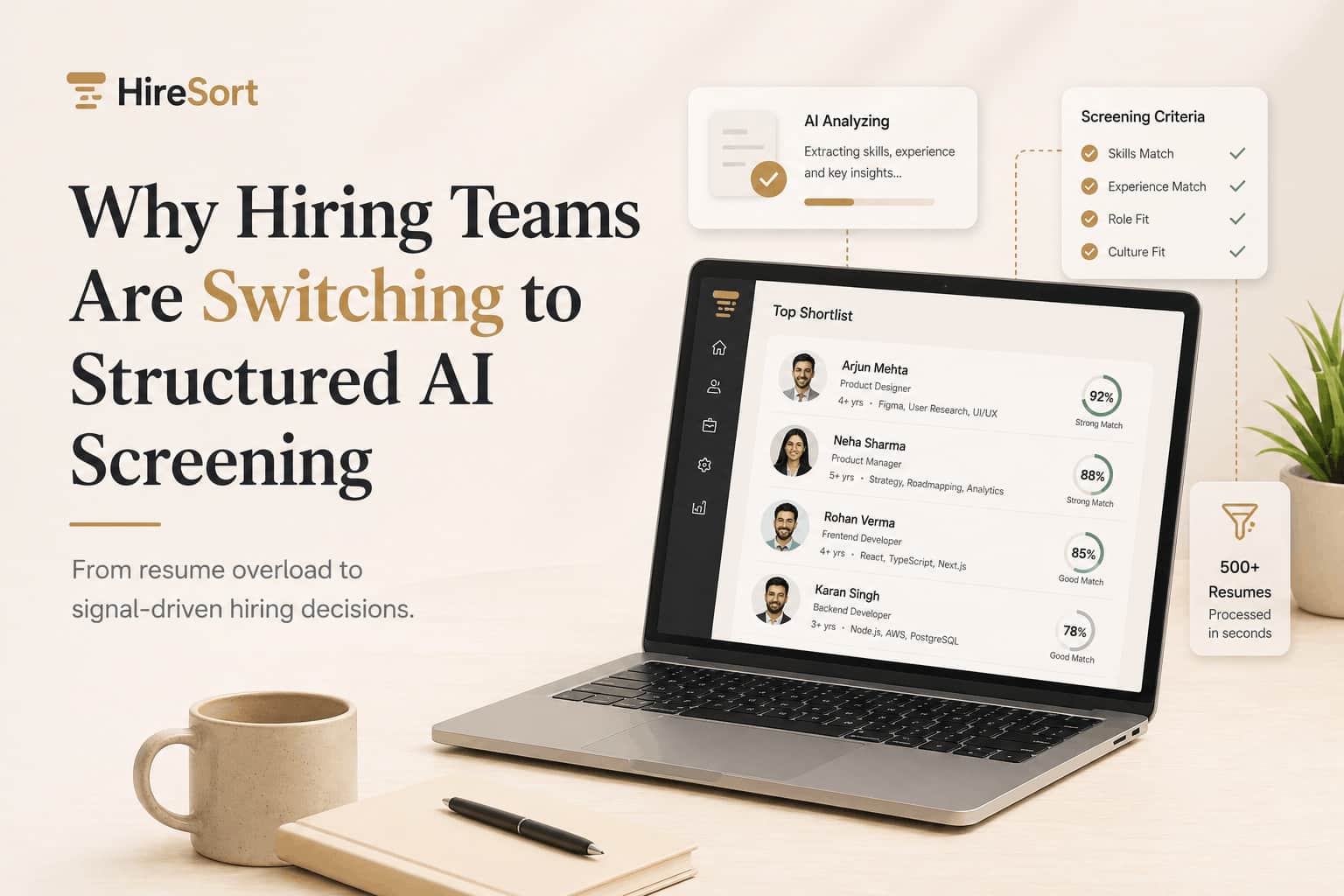
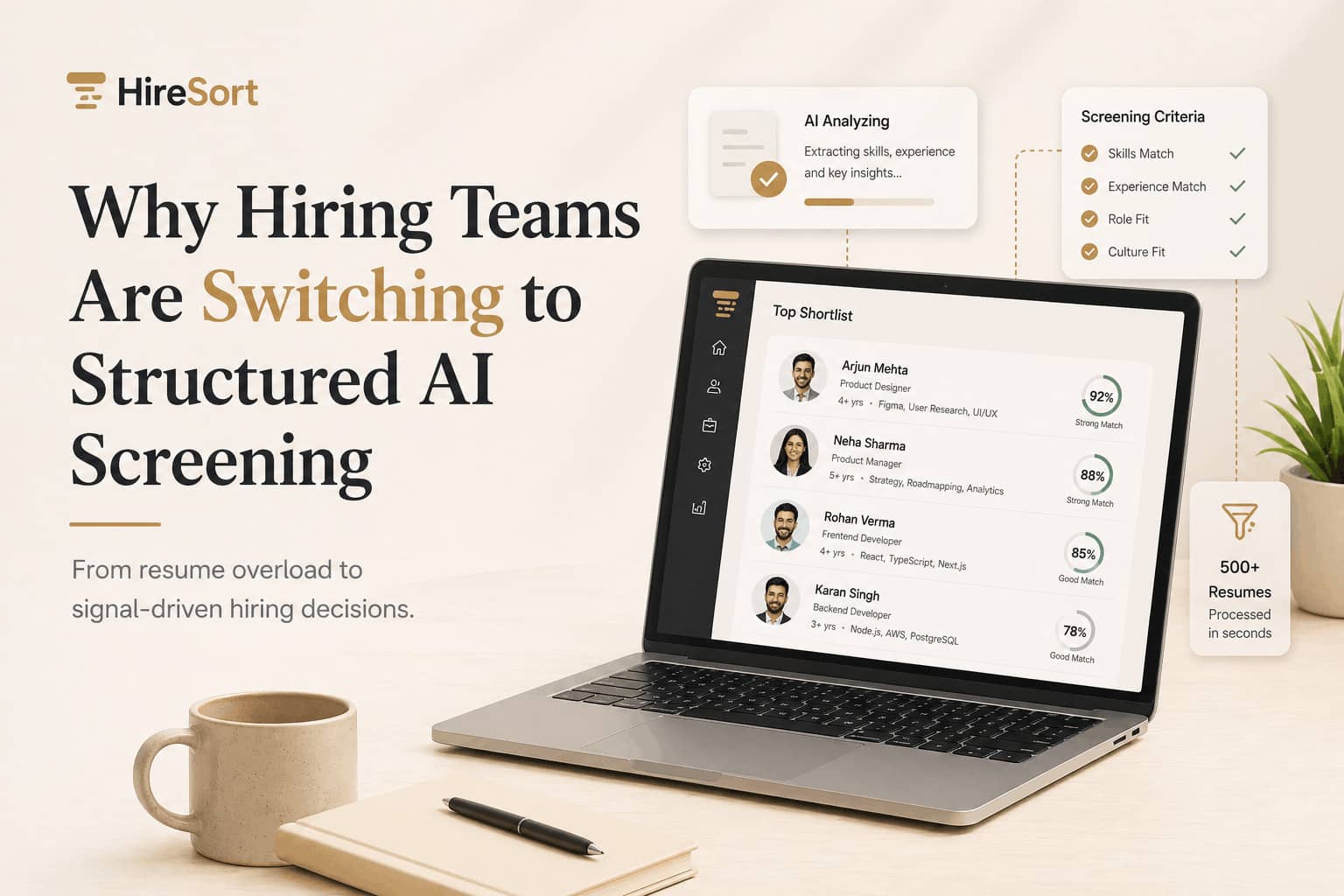
HireSort turns job descriptions into role-specific screening rubrics, scores resumes against those criteria, and shows strengths, gaps, and evidence for each candidate. That gives recruiters a structured starting point before the hiring manager review.
FAQ: What Should Be Included in a Recruiter Scorecard?
A recruiter scorecard should include role requirements, must-have skills, evidence notes, strengths, gaps, overall score, recommendation, and next step.
FAQ: How Do You Score Candidates?
Score candidates against role-specific criteria using a consistent scale. The score should be supported by resume evidence, interview answers, work samples, or assessment results.
FAQ: Should Recruiters and Hiring Managers Use the Same Scorecard?
They should use connected scorecards. Recruiters can score first-pass resume fit, while hiring managers can score deeper role capability during interviews.