Best ATS for Startups: Lightweight Tools for Founder-Led Hiring
A practical guide to choosing the right hiring workflow before your startup needs a full enterprise ATS.
Most startups do not need a complex ATS on day one. They need a simple way to collect resumes, screen candidates, track status, and avoid losing good people in a spreadsheet.
The best ATS for startups is not always a full ATS. In early hiring, the real pain is usually first-pass screening. A founder posts a role, receives applications, opens resumes between meetings, and tries to remember which candidates looked promising. This works for the first few hires. It breaks when application volume crosses 50, 100, or 200 resumes per role.
What startup hiring teams actually need
Startup hiring is different from enterprise hiring. The team is smaller, roles change quickly, and founders or hiring managers are often directly involved. A startup hiring tool should therefore prioritize speed, clarity, and flexibility.
- A fast way to compare resumes against a role.
- A simple candidate list that does not require heavy configuration.
- A clear scoring method so the team can discuss candidates objectively.
- Basic stage tracking, such as new, shortlisted, interview, offer, rejected, and on hold.
- A reusable resume repository for future roles.
- Low setup effort and low operational burden.
When spreadsheets are enough
Spreadsheets are useful for very early hiring. If you have ten candidates and one role, a spreadsheet can work. You can add columns for name, email, role, status, notes, and next step. The problem begins when resumes are scattered across email, job boards, LinkedIn, referrals, and folders. Spreadsheets do not read resumes. They do not score candidates. They do not explain why one candidate is better aligned than another.
When a full ATS may be too much
A full ATS becomes useful when you have multiple recruiters, structured interview loops, offer workflows, candidate communication, and compliance needs. But if your startup is still hiring its first 10 to 50 employees, a heavy ATS can feel like overkill. You may spend more time configuring the process than actually screening candidates.
Where AI resume screening fits
An AI resume screening tool gives startups a middle path. It is more powerful than a spreadsheet but lighter than a full ATS. It helps with the part of hiring that founders struggle with most: converting inbound applications into a serious shortlist.
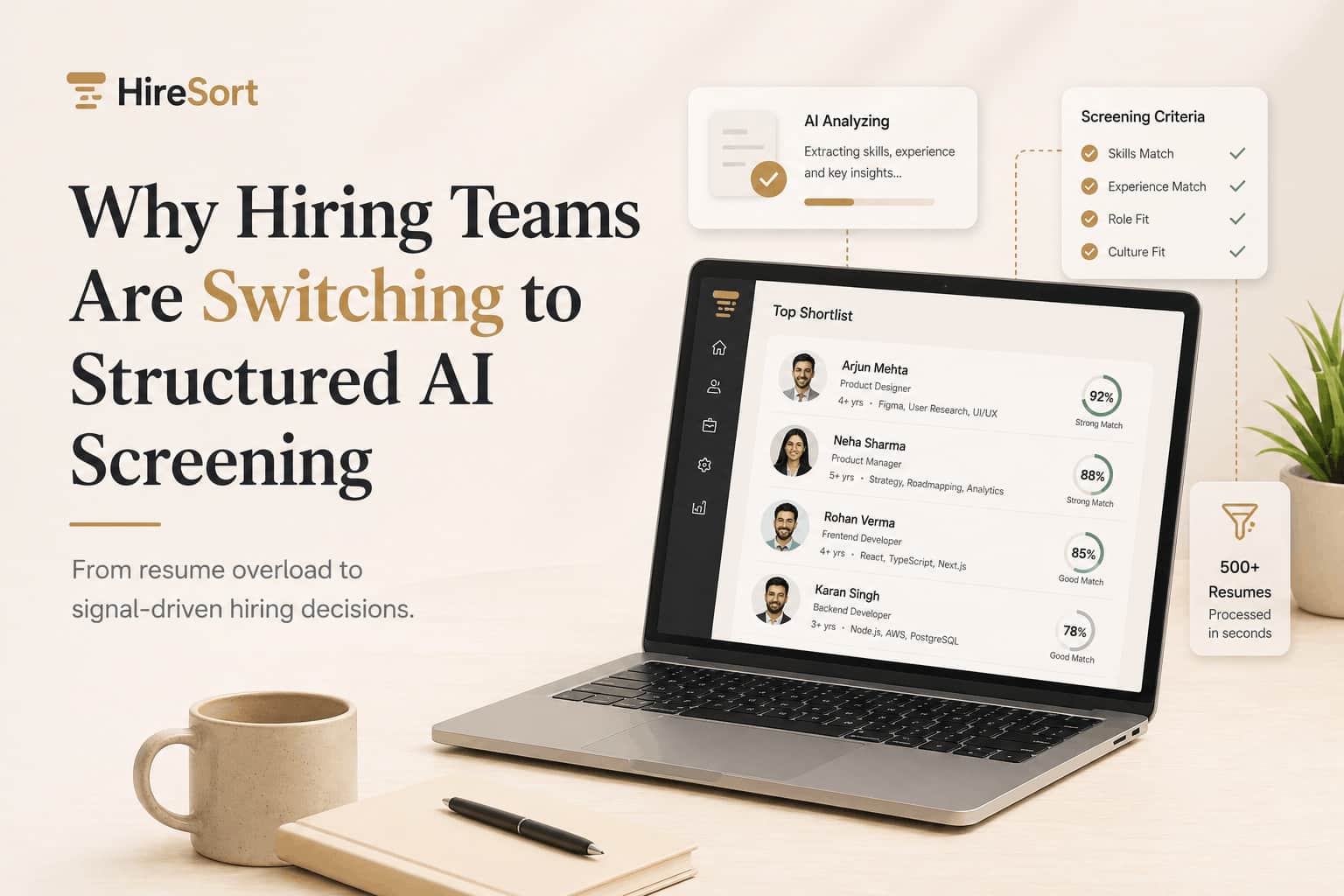
HireSort follows this approach. It is built to help teams paste a job description, generate a hiring rubric, upload resumes, and get a ranked shortlist with explanations. This gives founders and hiring managers a structured first filter before they spend time on calls.
Startup ATS evaluation checklist
- Can we start using it quickly?: Startups cannot afford long implementation cycles.
- Can it screen resumes, not just store them?: The first bottleneck is usually shortlisting.
- Can founders edit the scoring criteria?: Early teams often have role-specific judgment.
- Can we track candidate stages?: A simple funnel prevents candidates from getting lost.
- Can we reuse resumes later?: Startups often revisit candidates for future roles.
- Can it scale into paid workflows?: The tool should grow with the hiring process.
Recommended setup for early-stage startups
For the first 10 to 20 hires, use a lightweight workflow: create a clear JD, generate a screening rubric, score resumes, shortlist the top candidates, and track stages manually. Add complexity only when needed. Do not buy a heavy ATS before you have a repeatable hiring process.
Final takeaway
The best ATS for startups is the one that removes the immediate hiring bottleneck. If your team is drowning in resumes but not yet ready for enterprise recruiting software, use a lightweight AI screening layer like HireSort to create better shortlists faster.